Up next in 10

Government shutdown and debt ceiling
Jun 5, 2025

Jon Roland, Austin Constitution Meetup, Oct. 15, 2013
See http://constitutionalism.blogspot.com/2013/10/government-shutdown-and-debt-ceiling-faq.html
There have been a number of Frequently Asked Questions pages posted on the Net concerning the government "shutdown" and debt ceiling, which provide commonly conceived "answers", but it seems fitting to provide some more constitutionally enlightened answers to some of those questions.
Show More Show Less View Video Transcript
0:05
this is the Austin Constitution meet up
0:11
of October 15th 2013 I'm John
0:18
Rand uh this topic this evening first topic is uh government shutdown and the
0:26
de seal what I have on the screen is uh a Blog
0:33
posting at constitutionalism
0:38
blogspot.com uh which you can refer to to if you have trouble reading it in the
0:45
video uh and as time proceeds I'm adding
0:50
material to this posting so if you come back and visit you may find it's there
0:57
been more things added to it I wrote it as a fact frequently asked questions
1:04
since this is a fast breaking subject and a Blog posting provides a convenient
1:10
way to cover the subject because it's easy to add stuff to
1:15
it U so uh let's move on to a few of the
1:22
first question and it's
1:28
answer if there's no Congressional appropriation how can the government
1:34
keep spending money on quote essential unquote operations and the answer is
1:41
constitutionally it can there's no constitutional exception
1:46
for essential operations if Government complied with the Constitution it would have to shut
1:52
down all spending and proceed entirely using unpaid volunteers as it did at the beginning
2:03
uh the reason why government continues to operate and to spend money for what
2:10
it call it calls essential operations is there is a statute that allows for
2:18
that the power of the statute doesn't really say that he can spend money to do
2:23
that only that it can continue the operations and with the and it's just
2:30
understood that means spending money but in reality all it can really
2:37
do is call for volunteers to do things and not pay
2:42
them and although they might get paid eventually even when the appropriation
2:47
is passed by Congress uh they might never get paid and the recent uh bill that did get
2:58
passed by Congress uh retroactively paying people for services they might
3:04
perform during this uh current uh shutdown so-called sub
3:11
shutdown is really um a
3:17
mistake because everyone involved needs to understand that they may never get
3:23
paid and it creates a uh bad situation in that uh if people expect to get paid
3:31
eventually they may do things in inappropriately and there's also a
3:38
statute which forbids people to work for nothing apparently it's not being
3:45
applied or enforced for a lot of people and U uh the theory was that this
3:55
was a 19th century statute that if people could continue to work
4:00
voluntarily they would later have a complaint claim on the government for back
4:06
wages and the Congress of the time didn't want them to be able to claim
4:12
back wages or to use government resources so uh they have all kinds of
4:20
conflicts here which uh they're mostly trying to
4:25
ignore but what it does do from the viewpoint of all all factions in this dis
4:34
view first of all it allows the president the
4:39
administration to lay off people in a way that will put the most pressure on
4:46
the opposition on the other hand from the other party factions point of view it is
4:54
laying the burden on the president of deciding who to lay off
4:59
therefore he takes the heat from that for that so each side is essentially
5:05
Shifting the trying to shift the heat to the other side and giving uh putting the decision
5:13
of who to lay off and who not to lay off on the on the
5:20
administration okay next question how can some spending be
5:25
outside the appropriation process and constitutionally can it is done on the
5:32
rationalization that the constitution does not explicitly forbid setting up independent agencies that they may be
5:40
self-funded from their own taxes or fees or forbid multi-year Appropriations
5:47
for other than the Army but the Constitution doesn't authorize those things either and one cannot logically
5:55
infer a power from the emission of a Prohibition on
6:00
exercise the design established by the Constitution requires all revenues going
6:07
into the treasury and all dispersements to be made under Appropriations that may
6:13
not extend beyond the terms of Congress which are two-year
6:20
periods next why can't government workers
6:25
volunteer constitutionally there is no authority to stop them from doing so
6:30
although there was a 19th century criminal statute that forbids it the statute could constitutionally forbid
6:37
volunteers who use government-owned assets but the only authority to forbid
6:43
voluntary action would be to fire them and of course they're not work being
6:48
paid anyway and they could then volunteer as non-employees using their own resources of course if Government
6:56
prosecutors are fured there would be no one to enforce the statute somehow one suspects this is
7:04
something of a dead letter so who's the blame for the
7:10
shutdown the Constitution requires agreement by both houses of Congress and
7:16
the president to authorize spending from one year to the next
7:22
and not to authorize permanent appropriation for anything so the
7:28
default is to not spend and theault belongs to those who insist on spending
7:34
over the objections of one or the other components in this case the House of
7:39
Representatives which has Superior Authority as the only house that may initiate spending bills the compromised
7:48
position would be to cut all spending not agreed to by all the components which means that if the what
7:57
the house agrees to does not incl Obamacare and then the compromise would
8:03
be for the Senate to also not include Obamacare or whatever it might whatever
8:10
program or Department it might be uh there is contrary to some
8:18
uh our discussions in this field no
8:24
obligation of the government to spend money on anything it can literally not spend
8:30
money on anything now of course if it didn't spend money on defense we'd get invaded
8:37
and conquered it doesn't spend money on courts we'd be left with you know a
8:43
tooth and nail fighting on another for our rights so there all be all kinds of
8:50
undesirable consequences of not spending money on certain kinds of essential
8:55
functions but uh one can speak moral obligations but moral obligations are
9:02
not legal obligations and there is actually nothing in the Constitution that
9:08
requires the government to spend money on anything including the payment of
9:14
debts now it has sometimes been argued uh incompetently that section four of the
9:21
14th Amendment uh stating that uh the federal
9:27
debt may not be questioned is somehow a mandate to pay all federal
9:34
debts uh that's not true it's a requirement that they not be
9:43
repudiated but if there's no money they can't be paid and you can't
9:48
constitutionally create money out of thin air uh this practice of printing money
9:55
out of thin air to pay debts is UN constitutional even though it's become
10:02
an accepted practice why would the government
10:08
default if the dead ceiling is not raised well first of all it depends on what you mean by
10:14
default the way most economists use the term it would would only be failure to
10:20
pay interest on lawful Bond debt and principle on such debt when it comes due
10:27
and there's more than enough revenue from taxes to pay those things so from that Viewpoint there is
10:34
no risk of default if the dead ceiling is not raised however the way the
10:39
administration and supporters in Congress are using the term it is any
10:44
and all obligations or expectations of payment from payment of medical claims
10:51
on Medicare to vendors of goods and services to subsidies and grants to
10:56
keepy constituents that is a matter of not wanting to Cur the political cost of ending
11:06
patronage it is sometimes argued well that uh uh we paid into Social Security
11:15
therefore we are entitled to receive benefits well that's not
11:21
true there's a uh Supreme Court case Fleming theer which considered that and
11:28
Proclaim very clearly coldly and correctly that
11:35
uh no one who pays into social security has any property right in any amount of
11:41
money it can be cut off at any time and there's nobody no no one has any
11:47
standing to sue to get money what would happen if the dead
11:53
ceiling were not raised the government would have to immediately stop all spending in exess
12:00
revenues which would be a reduction of about 30% that would mean ending almost all
12:07
entitlement spending on things like Medicare Medicaid Farm subsidies food stamps housing subsidies education
12:14
subsidies and payments to government funded Pension funds arguably Social Security
12:22
benefits uh could continue as long enough as enough F taxes were collected
12:29
but since those taxes are not keeping up with Benefits those benefits would have
12:35
to be reduced and continue to fall Advocates of more spending and
12:40
borrowing make the kinyan argument that a sudden cut off would be disastrous to
12:46
the economy there would almost certainly be a shock from any Sudden Change in
12:52
government spending and many Enterprises that have grown to depend on it might go
12:57
bankrupt but reduced government's borrowing would also make more investment funds available to other
13:04
things like expanding businesses creating jobs and investing in new technologies so after a period of
13:12
adjustment the net effect is likely to be beneficial to the
13:18
economy and I might add on that point that uh we have the government has had
13:28
large layoff of people in the past after the first and second world
13:33
wars there was a demobilization of service
13:39
Personnel uh after World War II he went from uh 12 million employed service
13:47
Personnel to about 1.56
13:53
million that's uh more than 10 million people suddenly laid off off and thrown
14:00
on the economy and we managed to get through that now of course part of what was
14:06
going on there is that a lot of the jobs that the guys would have done uh before
14:14
the war were being done by women their wives and sisters and mothers and so
14:21
forth and after they were demobilized the women left those jobs and turned
14:28
them over to men but not completely um there was a period during
14:35
which absorbing that many people into the economy was of challenge but we
14:41
managed to do it I vaguely remember that period I was
14:47
just a little kid at the time but uh it was a subject of some discussion and
14:53
basically everybody pulled together to create jobs for all the returning servicemen
15:00
so uh that plus the GI bill which enabled a lot of them to go to college
15:07
and acquire degrees uh greatly uh in you know work fairly well
15:15
to deal with the situation so yeah if we had to lay off 30% of all federal uh
15:23
government employees uh we could do it it would be rough
15:29
be a lot of foreclosures maybe uh a lot of
15:34
bankruptcies you know it would be it wouldn't be easy but we could do
15:41
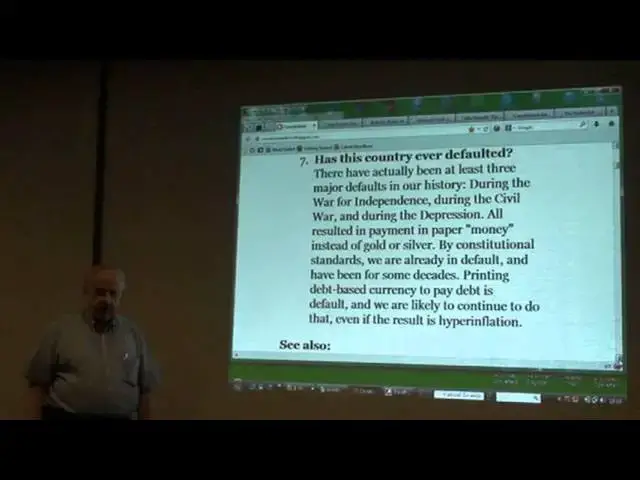
it uh next has this country ever defaulted a lot of people are saying
15:47
well we the with with country has never defaed that's not
15:52
true is that there have actually been at least three and arguably four defaults
15:58
in our history uh the first one was following the war
16:03
of independence technically the def proba can be said to have occurred during the
16:08
war before The Constitution was ratified but it came to a head in
16:14
1790 after the Constitution was ratified when Congress had assumed the debt of
16:22
all the states for the war and it it had already been issuing
16:28
Continental which are paper money both the central government and the state governments were issuing
16:35
Continentals but then we got the expression not worth continental and what happened there is
16:42
nobody could buy anything with them so what a lot of people who were
16:47
had received a lot of Continental dollars were doing uh were selling them to
16:54
speculators often typically for you know Pennies on the dollar
17:00
and those speculators later were able to
17:05
convert uh a lot of those mentals not to go there wasn't enough
17:11
gold but to land in the Northwest Territory the Ohio
17:17
Valley what is now the states of Ohio Illinois Indiana Kentucky and so
17:25
forth uh and they proceeded to develop the land sell it to settlers and
17:33
recover their investment that way uh the speculators made out all right most of
17:40
them uh the original recipients of it did not for the most part and uh so that
17:49
is technically a default but you notice that it was the default the response to the default was
17:56
to issue paper money well that happened happened again during the Civil
18:02
War uh during the Civil as early as 1862 the union found it did not have
18:10
enough gold to pay for the war so it passed the legal tender act in
18:16
1862 in which it would pay its debts in what became known as
18:23
greenbacks uh which vaguely resembl the paper money we still use
18:30
today uh after the war people well people were expecting
18:38
the green bags to eventually be redeemed in Gold but the federal government the
18:44
union government didn't have go to redeem them uh so people started
18:51
suing the union government now the national
18:56
government uh to those green bags in gold
19:02
and the government had the legal tender act which in effect allowed it to use
19:08
paper money and which was not backed by gold so uh it won the suit now there was
19:18
more than one case the legal tender cases and the first of the legal tender
19:23
cases the government lost the legal tender Act was called
19:29
deemed to be unconstitutional correctly but under pressure from uh the
19:37
Republican faction in Congress were not Republicans of today they were the ones
19:43
who were the dominant party in the during the Civil War um the Supreme Court Cav and in
19:51
subsequent legal tender cases it cited with a government and allowed it to
19:58
issue paper money backed by nothing in payment for its debts and further to
20:06
require that if that anyone that had such paper money could use it to pay
20:12
their debts and so forth so uh that was the beginning of paper money as we know
20:19
it today now by
20:26
1933 the uh paper money not backed by any gold or
20:33
silver was not accepted in payment for anything uh the government was issuing
20:42
silver and gold certificates which could be redeemed for silver or
20:49
gold and you might still occasionally find a silver certificate in
20:56
circulation uh but in 1933 the government didn't have enough gold to
21:01
redeem all of the gold certificates in that outstanding so
21:09
it passed the Banking Act of 1933 calling for all those gold
21:15
certificates to be turned in together with all
21:20
gold and so it sees all gold in private
21:26
hands except of course for a few Banks and other special favorite
21:31
parties uh of course a lot of people went and buried their gold and silver in the
21:37
ground my own uh Grandparents were among those but
21:43
uh they didn't have much to bury so it's didn't make much difference for
21:49
them but that was a deault again the defal took the form was
21:58
met by issuing paper money instead of gold and
22:03
silver so people were getting paid but not with what they expected to get paid
22:08
in now that was acceptable or deemed acceptable or sold you know to the
22:15
people as something that they could accept on the theory that the government
22:20
would not create more paper money at a faster rate uh than the
22:27
growth of the economy gold and silver were somewhat deflationary because the supply of them
22:34
was not growing as fast as the economy was growing even during the
22:39
Depression so uh or at least the years leading up to the
22:45
depression so uh by issuing money uh as the economy grew at a
22:53
moderate Pace uh they created a currency that people could could
23:00
accept with the expectation that it wouldn't become worth worthless by
23:06
having too much of it printed well
23:12
uh that hasn't worked out too well there was one more default or arguable default
23:19
in 1971 when Richard Nixon uh
23:26
abated uh us commitment to the Breton Woods Accords which was kind of
23:33
international treaty among the 42 leading Nations to back uh their National currencies in
23:42
gold for international transactions the United States was then
23:47
not able to meet that obligation so it simply abated his commitment to it well that is
23:56
the Practical effect of sinking the entire Bron Woods Accords for all the
24:02
nations involved and they all went off the gold standard so again that was a default and
24:10
it was uh the response to it was to replace the kind of money that people
24:17
were expecting to be paid in with what amounts to worthless paper
24:23
money uh now recently we have seen what could be considered
24:30
another kind of defa the issuance of unlimited amounts or not unlimited but
24:38
very large amounts of currency through the three rounds of qu so-called
24:43
quantitative easing now uh by historical standards one would
24:50
think that would generate a round of hyperinflation the reason why it hasn't
24:57
at least not yet because that currency is going into the
25:02
financial sector it's not going into Commodities
25:07
market and what I I like to liken it to uh
25:12
imagine a mouse with a tick on his
25:18
back the tick is sucking blood out of the moue as it sucks blood out of the mouth
25:25
it swells gets bigger and bigger the mouse is our Commodities economy The
25:33
Tick is the financial sector now
25:39
the financial sector is supposed to feed money back into the economy to help it
25:46
grow but when it gets uh involved in a speculative fervor it
25:53
grows within itself without regard to what it any
25:59
contribution it might make to the growth of the commodity sector
26:06
well when it gets to the point where it is facing
26:11
collapse and you pump more blood into it it continues to swell and swell and
26:17
swell until the mouse can't even move at some point the tick is going to
26:26
burst but it doesn't burst like a a ticked real life would Burse
26:31
spreading uh blood all over the cage Mouse cage it bursts through its mouth and
26:38
feeds all that blood into the mouth so when the financial sector does
26:44
finally collapse and it has to you know the way we're feeding speculation in it
26:51
then when it does suddenly everybody's going to be abandoning stocks B and
26:56
bonds and turning to Commodities and then you're going to see
27:02
hyperinflation and it could happen almost overnight so I propos some remedies for
27:12
this now there are several things that could be done in the short
27:18
term um I was involved in a tel Forum
27:24
Federalist Society Tel Forum a couple days a ago
27:30
uh well yes yeah yesterday uh in which
27:37
uh Senator Mike Lee one of the leaders of the key party faction in the Senate
27:43
was arguing for his balance budget amendment which is which is frankly a
27:48
very bad idea it would never work but it's also not a solution to the
27:54
current problem uh
27:59
what I proposed for just right now is for the Senate to offer a budget an
28:09
appropriation which budgets debt as well as
28:15
spending in other words Department by Department what we have now is a kind of
28:21
moral hazard departments are limited as to how much they can spend but not how much
28:28
debt they can generate so for example
28:34
a department of government may only have an appropriation to spend
28:41
$5,000 on office furniture but he can place an order for
28:49
$10,000 handar equ with des and if accepts delivery on it
28:58
it is arguably created a debt on the authority of the Department of head or
29:04
whoever is a purchasing officer of that department now you may say well okay but
29:11
they don't have the authority to spend the 10,000 no they don't but they had
29:17
created a debt which then becomes due from the general treasury not just from
29:24
the budget of that department uh
29:29
this kind un lack of control over the acquir generating or creating
29:36
debt is a key flaw in the budgetary process Simply Having a single debt
29:44
ceiling for the entire government doesn't do it it needs to be brought
29:50
down to the department and the program level and so what I have proposed is
29:56
that Congress and this could be done by a few members of it could simply in
30:02
their every appropriation Bill appr appropriate debt at the same time that
30:10
they appropriate spending so every department when it's
30:15
if it gets allocated say a billion dollars it gets allocated maybe $100,000
30:22
in debt debt Authority but no more so that would be that would bring a
30:30
lot of control over the
30:36
uh the monetary and fiscal discipline or
30:41
lack thereof that's now infest government uh that that could be done
30:48
right away but I do have some amendments three of them
30:54
actually uh the first one is he clarify
30:59
the concept of appropriation that no expenditure shall
31:05
be made or obligation incurred or committed by or for the government or
31:10
any activity under supervision except with in Appropriations enacted by Congress which
31:17
shall specify the amount and the department or activity it may support and which shall not exceed 6
31:25
years in other words there are few things where you might want to have six-year
31:30
Appropriations but they would also have to have six-year debt ceilings on a
31:36
department by Department basis and that would
31:43
include uh all of the Departments like Social Security Medicare Medicaid
31:48
everything that's now off budget it would no longer be possible under this amendment for people could write
31:56
themselves an obl ation just by applying for benefits as they can now right now
32:04
there's no limit on how many people may apply so
32:12
uh if you have a system where unlimited numbers of people can apply for benefits
32:19
you have a problem uh so if you have a ceiling on that
32:25
you'd have to have a ceiling on how many could apply and be accepted in any given
32:30
year fiscal year and if they exceeded that limit uh
32:36
they they'd be stuck until the next year and so forth
32:43
uh so that would take care of that problem now clarification of Article 1
32:50
Section 7 uh this is the section where
32:56
uh the it's it says that all
33:01
bills uh but it doesn't specify or at least doesn't make clear
33:07
to Modern readers that bills should include proposals within bills and any
33:13
proposal for raising or receiving revenues or dispersing funds including
33:18
for borrowing or lending shall originate in the House of Representatives and shall specify rates amounts objects and
33:27
purposes other words yet the house would have to spell it all out both not only
33:35
spending uh but also borrowing and give the exact amounts the
33:42
am exact rates was to be used for and what purposes to
33:49
serve three challeng of the debt this gets to
33:55
the uh
34:01
essentially clarifies section four of the 14th Amendment which says that uh no debt of
34:09
the federal government shall be questioned as I said earlier that only means it may not be repudiated that
34:17
doesn't mean that if there's no money to pay it that it has to be paid anyway uh this provides a remedial
34:26
measure procedure or
34:32
uh spending or debt that lacks authority so it says no debt by the
34:37
United States or any Department thereof shall be incurred or held valid that
34:43
funds consumption by other than military personnel and milit militia Personnel in
34:50
federal service or funds payment of principle or interest on existing debt
34:57
and any person May challenge the validity of any debt whereupon the
35:02
government shall have 20 days to prove it is authorized by law and not for
35:07
consumption except as provided above failing which the debt shall be redeemed
35:14
null and void in other words if Congress didn't
35:19
enforce its own laws if the executive branch didn't enforce its own laws if
35:25
the courts didn't enforce didn't enforce it that nevertheless any individual can
35:32
come in and challenge it this was essentially be a rid of
35:37
quto and if the government didn't prove it at Authority as provided here in the
35:44
the debt would be null and boid so uh it with the expectation that
35:52
their debts might become declared no and void it would be vendors not to sell
36:00
things to the government on credit without checking to make sure that uh it
36:06
had authority to make such a purchase on
36:11
credit uh so that covers this essential
36:17
Point uh and for and I guess we can
36:22
leave it at that for uh the present video for