Up next in 10

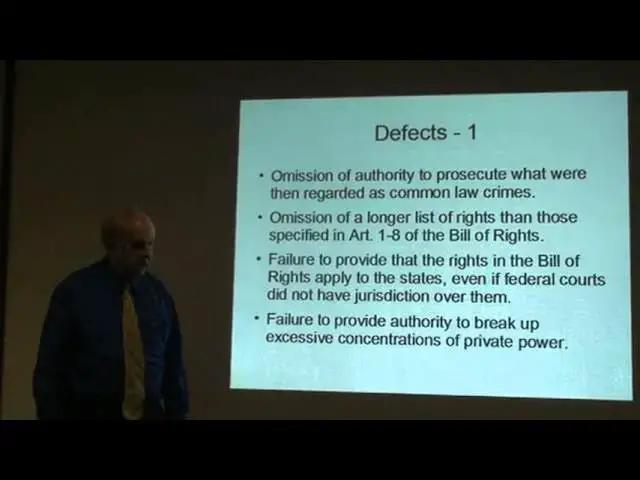
Jon Roland at the Austin Constitution Meetup June 18, 2013, discussed defects in the Constitution that were oversights by the Framers, and require amendments to correct them.
See http://constitutionalism.blogspot.com/2013/06/a-defect-in-constitution.html
Show More Show Less View Video Transcript
0:02
now good evening this is the June
0:07
18th
0:10
2013 us uh Constitution meet up of the
0:14
Austin Constitution Meet Up
0:16
group I'm John
0:18
Rand and this evening I'm going to be
0:21
discussing several current topics of
0:25
interest uh I appreciate if you hold off
0:28
on the questions until uh I finished uh
0:32
so that we can uh treat them separately
0:35
in the recording
0:37
session
0:39
now the first topic is defects in the
0:46
Constitution uh the framers of the
0:49
Constitution got so much right that we
0:53
are inclined to overlook sometimes the
0:56
things that they
0:57
overlooked but it didn't take very long
1:00
on for some of the over things they
1:03
Overlook to have become a
1:06
problem and they remain in many cases a
1:10
problem to this day they haven't all
1:12
been addressed with
1:16
amendments
1:25
so do a page down to get the next one
1:29
okay
1:31
okay there we
1:33
go um one of the first defects that I'm
1:37
going to discuss this evening is
1:39
omission of authority to prosecute what
1:43
were then regarded as common law
1:47
crimes now common law crimes were
1:52
the kind of crimes that were the subject
1:56
of most Court action on Criminal
2:00
action uh at the in England and the
2:03
American colonies at the time of the
2:07
Revolution uh they were not defined by
2:11
Statute they included things like murder
2:15
theft robbery rape
2:19
trespass uh
2:21
assault fraud
2:24
purgy and a host of other things that uh
2:30
for which we now have
2:32
statutes criminal
2:35
statutes but which at the time were
2:38
created only by Court
2:41
presidents
2:45
now the question arose shortly
2:48
after the Constitution was
2:51
adopted
2:53
whether there
2:55
were there was authority to prosecute
2:58
common law crimes
3:01
and it seems Apparent at this time
3:04
looking at the Constitution The Way It
3:06
Was Written the way was
3:08
debated that it seems likely that many
3:12
of the
3:13
framers thought that there would be
3:17
authority to prosecute common law crimes
3:20
so they didn't
3:23
mention or provide for specific
3:26
authority to do so
3:30
on the other hand as obviously some of
3:32
the other framers thought there would
3:34
not be such
3:37
Authority and apparently neither side
3:41
brought the issue to the attention of
3:43
the
3:44
other because they didn't include any
3:47
provisions in the Constitution to deal
3:50
with the
3:52
question uh you have something things
3:55
like the trial of all crimes as though
3:58
they were expecting to have lot of
4:00
them but in the Virgin conduct
4:05
resolutions of
4:07
1798 written by Thomas
4:10
Jefferson he pointed out that under the
4:13
Constitution Congress was authorized
4:16
only to prosecute for treason
4:20
counterfeiting piracy and felonies on
4:22
the high seas and offenses against the
4:24
laws of
4:26
Nations that's a substantial list of of
4:29
crimes but it's not a whole bunch of
4:33
them and they didn't come up that
4:36
often
4:38
so the question naturally arises when
4:42
they wrote a phrase like uh
4:46
uh removal from office for treason
4:50
bribery and other high crimes and
4:55
misdemeanors they later provided for
4:59
punishment for treason in the sense of
5:03
defining it and authorizing punishment
5:06
of it but they didn't mention bribery or
5:11
HRS and
5:13
misdemeanors so there was no
5:15
Congressional Authority authoriz granted
5:18
to criminally prosecute those things as
5:22
crimes but why did they mention them if
5:25
they didn't expect Congress to have the
5:27
authority to
5:30
rep pass statutes to punish them did
5:34
they expect that any punishment would be
5:36
done by the states what about the
5:40
territories so uh uh EV obviously they
5:44
didn't give much attention to this
5:46
subject but it came
5:49
up in 180 first of all in
5:53
1798 With the Alien and Sedition
5:57
Acts which Jefferson and Madison and the
6:00
other uh uh uh framers well Founders who
6:06
would we would might classify as wigs to
6:11
use the English term in English law or
6:15
politics uh people divided between wigs
6:18
and
6:19
tories the wigs were the what we would
6:22
dat today call
6:25
Libertarians and the Tories were more
6:28
likely we today call big government
6:33
conservatives
6:34
uh
6:37
the Jefferson at that point led a party
6:42
of what came to be called
6:45
Republicans and his opponents call
6:48
themselves
6:49
Federalists so the labels could change
6:52
but uh the concept remained the same
6:57
well the Federalists
7:00
were in favor of the federal government
7:03
having authority to prosecute crime and
7:05
law
7:06
crimes and the Republicans generally
7:09
were not but then some rep some
7:13
Jefferson appointed
7:16
Republicans in
7:18
Connecticut prosecuted a news the
7:20
editors of a newspaper named Hudson and
7:24
Goodwin for publishing a false article
7:28
that
7:29
had
7:31
illegally uh transferred $2
7:34
million uh to France uh for the purchase
7:38
of Western
7:39
Florida which was then known by
7:42
Spain well there was there was a secret
7:46
session of Congress to authorize the 2
7:50
million for a
7:53
negotiation through France with
7:56
Spain which ultimately didn't leave to
7:59
anything there was no money
8:01
transferred but uh uh so the Quran got
8:05
it
8:06
wrong but uh the Jefferson supporters
8:12
thought that that was constituted
8:14
criminal liable so they tried to
8:17
prosecute for it and since there was no
8:20
statute making criminal making liable a
8:23
crime it was had to be prosecuted as a
8:26
common law
8:27
crime which it could have been in
8:30
England
8:32
well the defense
8:35
argued that there were no common law
8:38
crimes under the US
8:41
Constitution which was a wig
8:44
argument
8:46
well uh it took until
8:49
1812 for the case to finally make it to
8:52
the Supreme
8:54
Court by which
8:56
time uh most interest in it been
9:00
lost the prosecutors didn't even show
9:04
up and uh the prevailing argument uh was
9:10
essentially a Jeffersonian one although
9:13
not prosecuted originally by
9:16
jeffersonians that there were no common
9:18
law crimes and that was a case of United
9:22
States versus Hudson and
9:25
Goodwin which is discussed on my website
9:29
constitution.org
9:34
now the what's interesting about that is
9:38
that it created a vast
9:41
area of non-authority on the part of the
9:45
federal government which it has been
9:47
trying to fill in ever
9:49
since with
9:52
uh he said what amount to
9:56
usurpations uh
9:59
some of which
10:00
are uh you know to do things that are
10:04
arguably needed with which it does not
10:07
have
10:08
authority and others of which is clearly
10:11
Beyond its Authority and should
10:13
be
10:15
now uh much more example of what's done
10:19
with the Commerce and necessary Proper
10:22
Clause is essentially to deal with the
10:25
lack of authority to prosecute many
10:28
kinds of Crim
10:30
CRI for example there is no authority to
10:34
prosecute for the crime of failing to
10:35
obey a court
10:37
order or even to enforce the court
10:40
order uh that that's kind of an
10:42
important Omission well they just loss
10:45
over it and say well that's an inherent
10:48
power of the Court well it might be an
10:51
inherent power of the court but it's not
10:52
an inherent power of congress or the
10:55
executive
10:56
branch so uh
11:04
the uh problem
11:07
then really needs to be addressed with a
11:11
new set of
11:12
amendments which I have
11:14
proposed
11:16
under uh my draft amendments in the
11:20
second section on remedial
11:23
amendments the first section is on
11:25
clarifying amendments that's clarifying
11:28
the langu langage of existing Provisions
11:32
to make them uh less
11:35
ambiguous the second section is on
11:37
remedial amendments that's to remedy
11:40
defects of they were essentially
11:43
oversights and then the third are
11:45
substantive amendments things
11:48
that uh we really should be able to do
11:52
and for which there's no
11:54
Authority even though there in many
11:56
cases we're doing it anyway
12:00
uh the
12:02
second major
12:05
defect is the omission of a longer list
12:08
of Rights than those specified in
12:10
Article 1 to8 of the Billa
12:12
rights Jefferson and the others simply
12:15
lumped the others into the Ninth
12:18
Amendment but that has proven not to be
12:22
adequate because nobody no modern lawyer
12:25
or judge seems to be willing to go back
12:29
into history and find out what those
12:32
other unenumerated rights
12:35
are they are in fact they're downright
12:38
resistant to it so uh it really they
12:41
really need to be spelled out and I have
12:45
proposed
12:46
legislation that would spell it out as
12:48
an amendment to the Civil Rights Act you
12:51
know for simply listing them all it runs
12:53
us many pages it doesn't claim to cover
12:57
all rights but it covers so many that uh
13:01
you know what's left is pretty
13:06
obscure
13:08
now the third
13:11
major uh defect is a failure to provide
13:16
that the rights and the Bill of Rights
13:18
apply to the states even if federal
13:20
courts don't have jurisdiction over
13:23
them now that was presumed at the time
13:27
Most states had their own of Rights so
13:30
we thought well the states have it
13:32
covered but in fact the states didn't
13:34
have it
13:35
covered and uh that still leave would
13:39
leave the question whether putting the
13:42
Bill of Rights in the Federal
13:44
Constitution made them Federal questions
13:47
that would confer jurisdiction on
13:50
federal courts to adjudicate cases
13:54
between a citizen and his own
13:57
State um
13:59
that was the issue in Baron B
14:04
Baltimore uh which uh in which a
14:07
individual who had had a
14:11
Warf uh Jason the city of
14:14
Baltimore and as a result of uh dredging
14:19
projects by the
14:21
city uh it rendered his Warf
14:26
useless essentially landlocked it
14:30
so he sued for damages claiming that
14:33
Baltimore had uh deprived him of
14:36
property without due
14:39
process and the holding by Justice Chief
14:42
Justice John Marshall was that the Bill
14:46
of Rights did not apply to the states or
14:50
more precisely that the federal courts
14:53
did not have jurisdiction to adjudicate
14:55
such
14:57
cases now what was really really going
14:59
on
15:01
there is that it was recognized emerg
15:06
from the case that if the Bill of Rights
15:09
were to apply particularly the Fifth
15:12
Amendment to the
15:14
states and it includes the Clause no
15:19
person shall be denied life liberty or
15:24
property without due process of
15:27
law and black were persons and they were
15:31
considered persons then that would
15:33
essentially rule out
15:36
slavery and Marshall and the others
15:40
apparently thought that if they were to
15:42
come down on the other side that they
15:45
would be laying the basis for declaring
15:49
slavery
15:50
unconstitutional and that would trigger
15:52
a civil war so it was a political
15:56
decision not a principal position
15:59
position based upon the actual text of
16:02
the Constitution or or the logic of it
16:05
but the 14th amendment was intended to
16:10
overturn Baron B Baltimore and also
16:13
Dread Scott V
16:15
Sanford those two cases
16:17
primarily and it was felt necessary to
16:20
adopt an amendment because by that point
16:24
those cases have become so entrenched
16:26
with further precedents built upon
16:29
them that the only way to unravel those
16:33
precedents was to adopt an amendment
16:36
which is why I proposed so many
16:38
amendments because at this point the
16:41
only way to unravel all the bad Court
16:44
precedence is to amend them into a state
16:49
of which they were the Juris Prudence
16:52
was before the first such precedents
16:55
were established
17:00
now next would be a failure to provide
17:03
authority to break up excessive
17:06
concentrations of private
17:08
power there is actually no Authority for
17:11
the Antitrust
17:12
Act to break up monopolies and things of
17:16
that
17:17
sort uh that was uh argued to be a uh
17:24
under you know an implied power of the N
17:27
of the Commerce Clause but that doesn't
17:30
really
17:31
work that the most that could be done
17:33
would be to create a civil jurisdiction
17:36
for private parties to sue large
17:41
organizations uh and seek breakup as a
17:44
remedy but he would not authorize the
17:47
government to appear as a
17:49
party so it's especially not to provide
17:53
for criminal penalties so uh uh large
17:57
organizations large Banks Banks uh
18:00
holding companies uh labor unions
18:03
monopolies whatever uh were are
18:07
essentially beyond the reach of law
18:11
under the Constitution as it was
18:14
originally
18:18
written now next would be failure to
18:21
specify standards for trial and grand
18:25
juries the framer simply used the term
18:28
Tri you know jury or grand jury and
18:31
assume that everybody would know what
18:33
they meant by
18:35
that but they didn't
18:38
anticipate that later generations would
18:41
try to define those things out of
18:45
existence especially at the state
18:47
level and by cleverly
18:52
manipulating process and
18:54
structure uh reduce them to a much less
18:57
effective level
19:00
uh so what are needed there are for the
19:04
standards to be made clear and made
19:08
specific and on my website Constitution
19:12
or I have that laid
19:16
out next was a failure to protect
19:19
private prosecutions of public rights
19:22
such as PO on to an avus
19:25
Corpus uh avus Corpus link lingers on
19:29
but it's been changed from something
19:32
that it can be done
19:35
without the help of a court is something
19:38
that requires Court approval you apply
19:41
for R of apus Corpus now originally you
19:45
just filed a rid of aus Corpus and the
19:50
the court didn't have to accept it as an
19:53
application it was not some kind of
19:56
petition and these were the tools that
20:00
enabled private citizens to hold
20:02
government
20:03
accountable and without them government
20:06
cannot essentially not be held
20:10
accountable next was the failure to
20:13
require common law rules of
20:15
construction specifically the
20:17
presumption of
20:19
non-authority uh that was presumed at
20:22
the time but it has to be spelled out
20:26
because I encounter in debates all time
20:29
with lawyers including law
20:32
professors uh that you know they're
20:35
asking me to
20:36
prove that delegations of Power are
20:39
supposed to be interpreted
20:42
strictly they say well why can't they be
20:44
interpreted broadly and writes narrowly
20:48
you who says that powers may only be
20:52
interpreted strictly well it was assumed
20:55
at the time that that was the way
20:58
things work but you can't assume that
21:02
you have to write make it
21:04
explicit uh a failure to forbid binding
21:09
star
21:11
decises it was assumed that uh Court
21:15
decisions would apply only to the
21:17
parties to the
21:19
case and that U president would at most
21:24
be advisory suggested never binding and
21:29
yet through practice it has become
21:31
binding and that is a threaten a threat
21:35
to the Constitution itself because it
21:37
allows B binding precedents to be given
21:42
more weight than the
21:44
Constitution finally there's a failure
21:47
to provide authority to enforce court
21:50
orders uh they do it anyway but it's the
21:54
authority is
21:56
missing which I mentioned earlier
21:59
so
22:02
uh I mentioned earlier common law
22:05
crimes just just summarizes
22:09
them the the but the basic problem with
22:14
common law crimes is they are defined at
22:17
trial not before the ACT is committed
22:21
and therefore they are inherently
22:23
exposed
22:24
facto and the Constitution prohibits
22:28
Expos Factor
22:29
laws both for the federal government and
22:32
for the states so because it does it is
22:37
essentially prohibits common law crimes
22:40
both for the federal government and for
22:42
the states except that in some states
22:45
they still try to prosecute common law
22:48
crimes uh at the state level
#Law & Government
#Government
#Constitutional Law & Civil Rights